


Working on a motorcycle at home becomes much easier when the rider has the correct tools nearby. A basic motorcycle maintenance tool kit helps with oil changes, chain adjustment, brake inspection, and many other regular service jobs. Even a simple collection of affordable tools can support most maintenance tasks without spending extremely large amounts of money.
Why a Motorcycle Tool Kit Is Important
Many motorcycle owners begin with only a screwdriver and one random wrench in the garage. That setup usually becomes frustrating very quickly because motorcycles use many different fasteners, adjustment points, and service procedures.
A proper motorcycle maintenance tool kit saves time and reduces damage to bolts, screws, and engine components. Riders also avoid many repair shop costs by completing simple maintenance at home. Oil service, brake bleeding, battery replacement, and chain adjustment often require only basic equipment when handled correctly.
Portability also matters for many riders. Some people work outside in apartment parking areas or small garages with limited storage space. Compact tools inside one carryable toolbox make maintenance easier in those situations.
Combination Wrenches and Socket Sets
Combination wrenches belong in every motorcycle garage because they work on many motorcycle fasteners. Most metric motorcycles commonly use sizes between 8 mm and 19 mm. One side of the wrench stays open while the opposite side uses a boxed design for stronger grip.
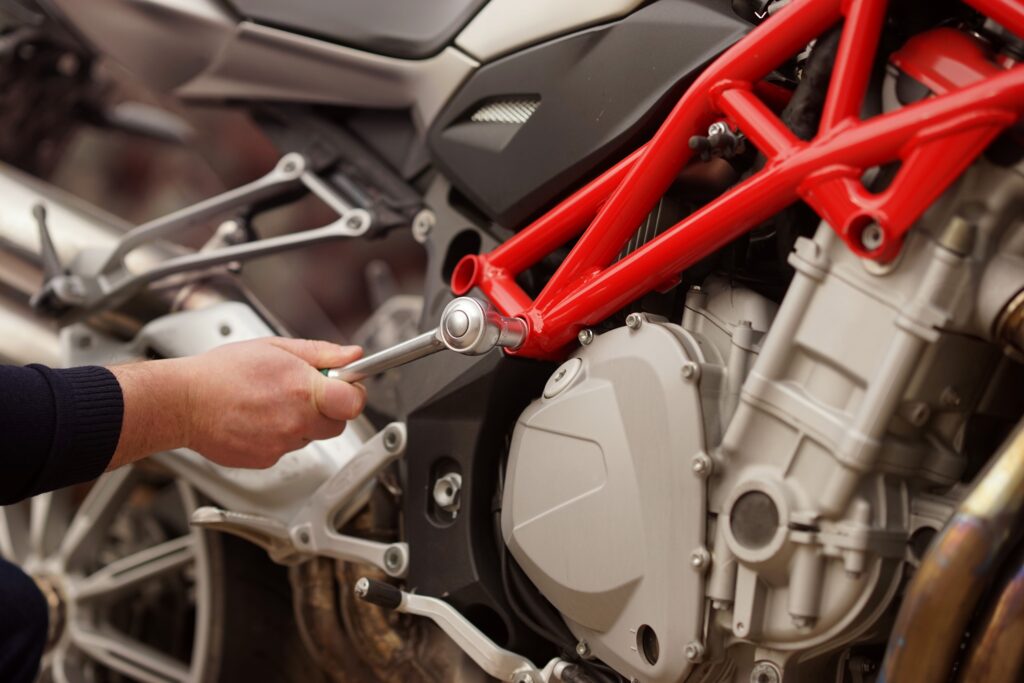
Sockets are equally important because many motorcycle repairs require ratchets and extensions in tight spaces. Shallow sockets are good for normal access, deep sockets are good for spark plugs and longer bolts.
Choosing the Correct Socket Types
Six point sockets usually grip bolts more securely and reduce the chance of rounding corners. Twelve point sockets fit easier in tighter spaces and engage fasteners faster during repetitive work.
A motorcycle tool kit normally includes these important socket related items:
- Shallow socket set.
- Deep socket set.
- Ratchet with extensions.
- Socket adapters.
- Socket organization rails.
- Large axle socket if required by the motorcycle.
Many motorcycles also need unique axle tools or unusual socket sizes depending on manufacturer design. Riders often discover these special requirements during tire changes or suspension work.
Ratchets, Torque Wrenches, and Breaker Bars
A 3/8–inch ratchet works for many motorcycle service jobs. Higher tooth count ratchets allow movement inside narrow engine spaces because they require less handle rotation between clicks.
Torque wrenches are essential for motorcycle maintenance. Over–tightening bolts improperly can damage threads, warp components, or allow critical hardware to loosen during riding. Axles, brake calipers, handlebars, and engine fasteners all have a specific torque value.
Torque wrenches that are affordable still work well for home maintenance. You might find that the more expensive tools feel smoother and more powerful, but economy models are often precise enough for everyday service jobs.
There is also room for breaker bars in the tool kit. These bars give you extra mechanical advantage to remove tight or corroded bolts. Never substitute a torque wrench for a breaker bar, as loosening bolts can mess up the internal calibration mechanism.
Screwdrivers and Hex Wrenches
Modern motorcycles use fewer screw fasteners compared with older designs, although screwdrivers still remain useful around fairings, battery covers, clamps, and electrical components.
A complete screwdriver set should include several Phillips and flat blade sizes. Magnetic tips help hold screws during installation inside difficult spaces around the motorcycle frame or engine.
JIS Screwdrivers for Japanese Motorcycles
Older Japanese motorcycles often use JIS fasteners instead of regular Phillips screws. These fasteners look similar but use slightly different shapes. Standard screwdrivers may slip and damage screw heads more easily.
JIS screw heads usually contain a small dot beside the slot. Riders working on older Japanese motorcycles often benefit from purchasing at least one correct JIS screwdriver to avoid stripped hardware during maintenance work.
Hex wrenches also appear almost everywhere on modern motorcycles. Riders commonly use them on body panels, brake components, controls, and chassis bolts. Ball–end hex keys improve access at awkward angles, while hex sockets allow accurate torque application on larger fasteners.
Pliers, Hammers, and Tire Pressure Gauges
Pliers are used for a lot of jobs when working on a motorcycle. Riders use them for cutting zip ties, removing clips, holding cables, bending cotter pins and gripping damaged fasteners.
Several plier styles are especially useful:
- Needle nose pliers for small spaces.
- Standard pliers for gripping tasks.
- Adjustable groove pliers for larger fittings.
- Vice grip pliers for damaged bolts.
- Cutting pliers for wires and zip ties.
Snap ring pliers also become necessary for certain motorcycles using retaining clips around bearings or transmission parts.
Dead blow hammers provide controlled force without damaging motorcycle surfaces. Plastic hammer heads reduce marks on aluminum covers, axles or suspension parts during removal and installation work.
Tire pressure gauges remain one of the most important motorcycle tools because tire pressure strongly affects handling, tire wear, fuel economy, and braking performance. Many riders prefer analog gauges with flexible hoses because they often provide more stable readings than simple pencil gauges.
Oil Change and Brake Bleeding Equipment
Oil service becomes one of the first maintenance jobs many riders perform at home. Oil changes require only several simple items but correct preparation prevents large messes and wasted fluids.
A basic oil service setup usually includes:
- Oil drain pan.
- Funnel for clean filling.
- Oil filter wrench.
- Replacement oil filter.
- Correct motorcycle oil.
- Rags or towels for spills.
Drain pans with sealed lids help transport used oil safely for recycling later. Funnels reduce spills around engines and fairings during filling.
Brake bleeding equipment also stays affordable. Clear vinyl hose allows riders to watch air bubbles leave the brake system during fluid replacement. Some people also use one way bleeding valves to simplify the process while working alone.